
Agricultural Risk Intelligence Infrastructure
Every analysis in Umay Ana is more than a momentary AI computation. Each photo adds a new data point to the system together with crop, location, time and observed risks.
The AI cost of that computation is currently approximately $0.05 per analysis on average, and it continues to fall as technology improves. The information created by the analysis, however, does not disappear; it becomes a persistent agricultural signal with regional and temporal context.
With every new analysis, Umay Ana therefore does more than answer a user. It builds an information asset that connects field observations, grows stronger over time and continuously increases in value.
The compute cost occurs once. The value of the data grows with every new analysis.
This cost falls every year as models get more efficient.
A signal gathered once feeds portfolio and risk models for years.
AI cost per operation drops yearly; the same budget buys ever more analysis.
Real-world field data like this is unique — it cannot be copied or re-created.
Each analysis deepens the data layer; institutional dependence and strategic power grow.

Guides farmers step by step through the transition to sustainable and regenerative practices. Helps lower input costs and increase yield and production resilience.
For you: You monitor the production quality and risk profile of the farmers in your portfolio with real field data — supporting your credit decisions with stronger evidence.

Turns farmers' production activity into measurable carbon and sustainability indicators.
For you: You gain the ability to measure your portfolio's environmental performance — and a stronger, verifiable data foundation for your relationships with the EU, development banks and sustainable finance sources. A data advantage in accessing sustainable financing.
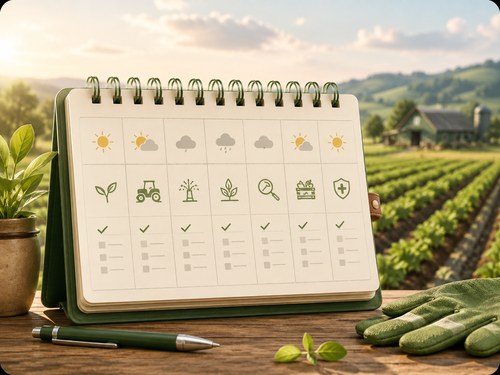
Warns farmers in advance about weather anomalies, climate variability, disease risk and poorly timed farming operations.
For you: You can monitor the risk of the agricultural portfolio you insure while production is under way — not only after a loss occurs. You build a real, continuous, field-generated risk database you can bring to reinsurance discussions.
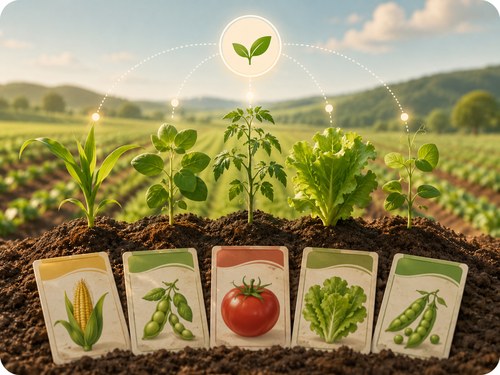
The producer sees which crop is the smarter investment, based on region, climate, soil, season and historical data.
For you: You start seeing months in advance which crop will be grown where in your portfolio, at what volume, and with what risk profile.
The EU's carbon removal and farming framework (CRCF, EU 2024/3012) is in force, with its first certification methodologies formalized in 2026. Corporate sustainability reporting mandates like CSRD demand similarly verifiable field-level data. A financial institution that invests in or partners with Umay Ana gains, through the Carbon Diary module, a photo- and location-verified record of sustainable practice at the farmer level — a concrete evidence layer that strengthens the institution's own EU funding applications (EIB/EIF, InvestEU, green credit facilities) and ESG reporting.
Farmer-level log of sustainable practices with photo, location and date evidence.
The verifiable, field-sourced data structure these frameworks call for.
Concrete, field-sourced evidence for institutions applying to EIB/EIF, InvestEU and green credit facilities.
Note: Umay Ana is not a carbon credit certification body; what it provides is a verifiable field-evidence layer. Final certification is carried out by authorized third-party bodies.
An effective approach to earlier risk detection and reducing the probability of loss. Field signals can help institutions see emerging risks sooner and support decisions with stronger evidence.
Connect crop health and harvest risk to credit decisions.
Risk segmentation, earlier claims visibility and parametric design.
Independent field signals for exposure visibility.
Disease clustering, crop stress and intervention priority.
Monitor health/risk trends across sourcing regions.
Measure field outcomes from finance and support programs.
These are not valuation claims for Umay Ana; they are independent indicators of the size of the risk pool the platform is designed to address.
1991–2023
FAO, 2025Roughly 4% of global agricultural GDP.
FAO, 2025About 55% of insurable crop value is unprotected.
Swiss Re Institute, 2024Only 9% are under 35.
USDA, 2022 Census33.2% are 65 or older.
Eurostat, 2020 censusAbout 155 million hectares of agricultural land.
Eurostat, 2020 censusWith appropriate consent, privacy and governance, analyses can be structured by time, region, crop/livestock type, visual findings and risk signals. At scale, the sum of individual analyses can become a new institutional data asset.
Use at the real point of decision.
Image, diagnosis, care, risk.
Time + geography + diversity.
AI built around agricultural workflows.
Credit, underwriting, reinsurance, government.
More signals → better intelligence.
A common AI and data backbone is localized around crop calendars, climate, regulation, language and production practices.
Large-scale farms, crop insurance, agri-finance and high digital adoption.
Risk + Finance + Scale9.1 million farms, ageing managers and strong traceability needs.
Traceability + RenewalLarge production geography and regional risk visibility.
Geography + Early WarningHigh quality expectations, labour and generational pressure; a case for AI knowledge continuity.
Quality + KnowledgeModernizing agriculture, water/climate pressure and public-sector digital transformation.
Modernization + Public SectorThis roadmap is an operational and strategic scenario, not a financial commitment.
Unify crop + livestock schemas and establish data quality, consent and provenance.
Expand localized product/data logic across the five strategic regions.
Dashboards/APIs, regional risk and early warning for banking, insurance, reinsurance and government.
Strengthen outbreak, crop-stress and portfolio-risk models with denser time series.
Strategic value is determined less by user count alone and more by field visibility, data uniqueness, AI expertise and depth of institutional workflow integration.
Strategic framework; not a commercial commitment or financial projection.
Access to real decision points.
Deepens across time and geography.
Specializes in agricultural workflows.
Decision products become embedded in workflows.
More contribution improves intelligence quality.
If Umay Ana converts large-scale field interaction into trusted agricultural signals, localizes one intelligence backbone across continents, raises decision quality for producers, preserves agricultural knowledge for new generations, and gives finance and government earlier visibility into field risk, its value will come from occupying critical infrastructure — not from a mobile-app multiple.