
01 / Contracting
Master Services Agreement
Core framework for enterprise licensing, APIs, data, IP, confidentiality, liability and Order Forms.
Open PDF (English)
Agricultural Intelligence & Risk Infrastructure
Umay Ana Vertical AI

“Don't wear out your soil. Or your wallet.”
Fewer inputs, healthier soil, stronger yields.
Umay Ana uses AI to recommend sustainable and regenerative farming methods suited to your region and crop, step by step. Cut back on fuel, fertilizer and unnecessary tillage while preparing your soil for the future.

“Record it today. See its value tomorrow.”
Log today's farming, get ready for tomorrow's opportunities.
Log your production activity regularly, track your carbon footprint, and build your own data history — one you can use for future sustainable farming support, financing and carbon programs.
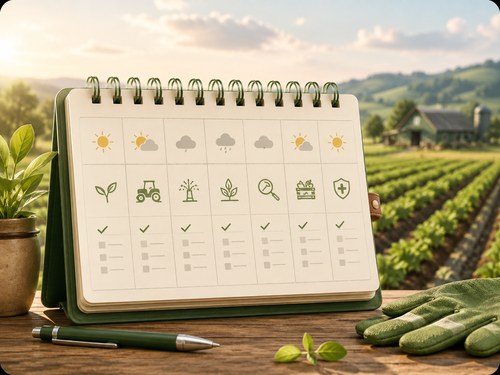
“The next 7 days of your field or garden, in your pocket.”
Let Umay Ana tell you what to do in the field this week.
Weather, your crop, your region and current conditions are all evaluated together by AI. See your weekly roadmap in advance — for irrigation, fertilizing, upkeep and risk.
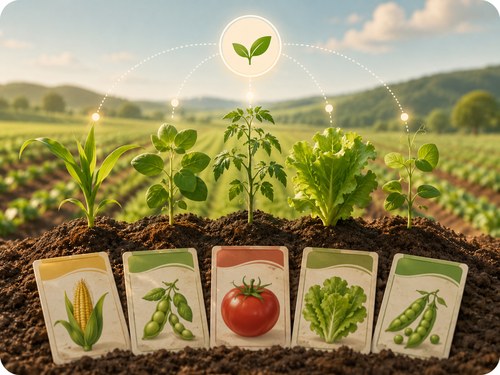
“Don't guess what to plant. Ask the data.”
What could you plant to earn more from your land?
Select your region. Umay Ana uses AI to analyze past climate data, current conditions and the period ahead — and shows you which crops suit your region best, and why.
Umay Ana starts with a live application that creates value for farmers, then turns structured field signals generated by each analysis into decision intelligence for banks, insurers, reinsurers, ministries and the agricultural industry.
Banking · Insurance · Reinsurance · Public sector · Agribusiness
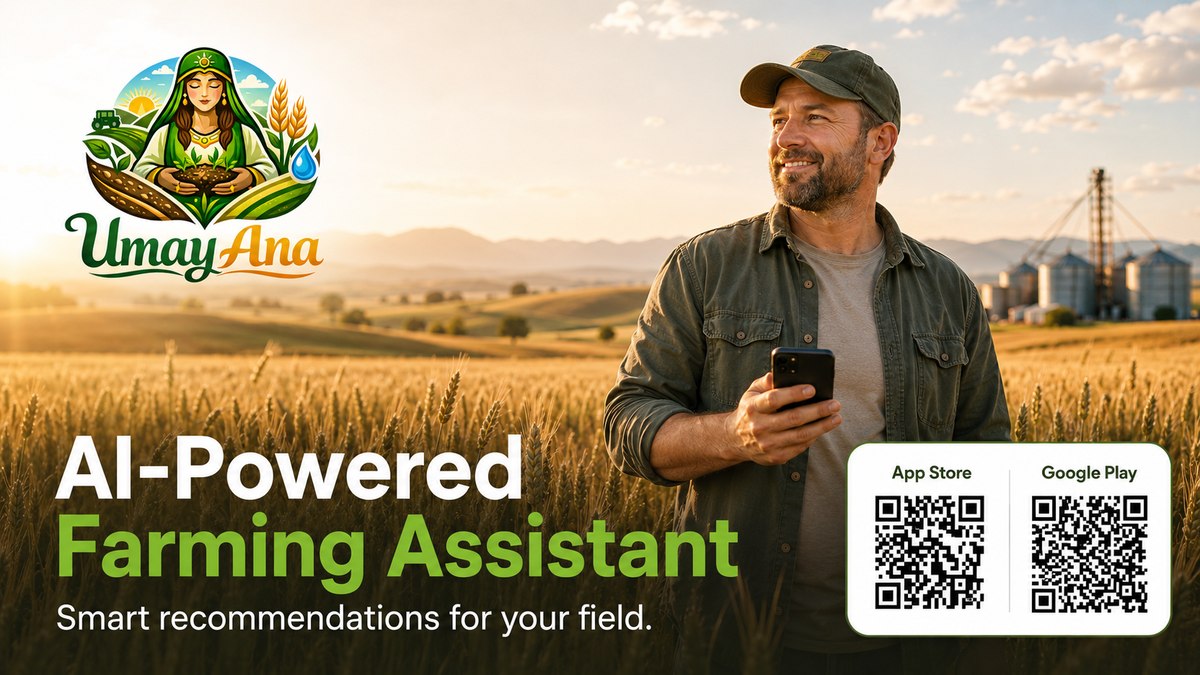
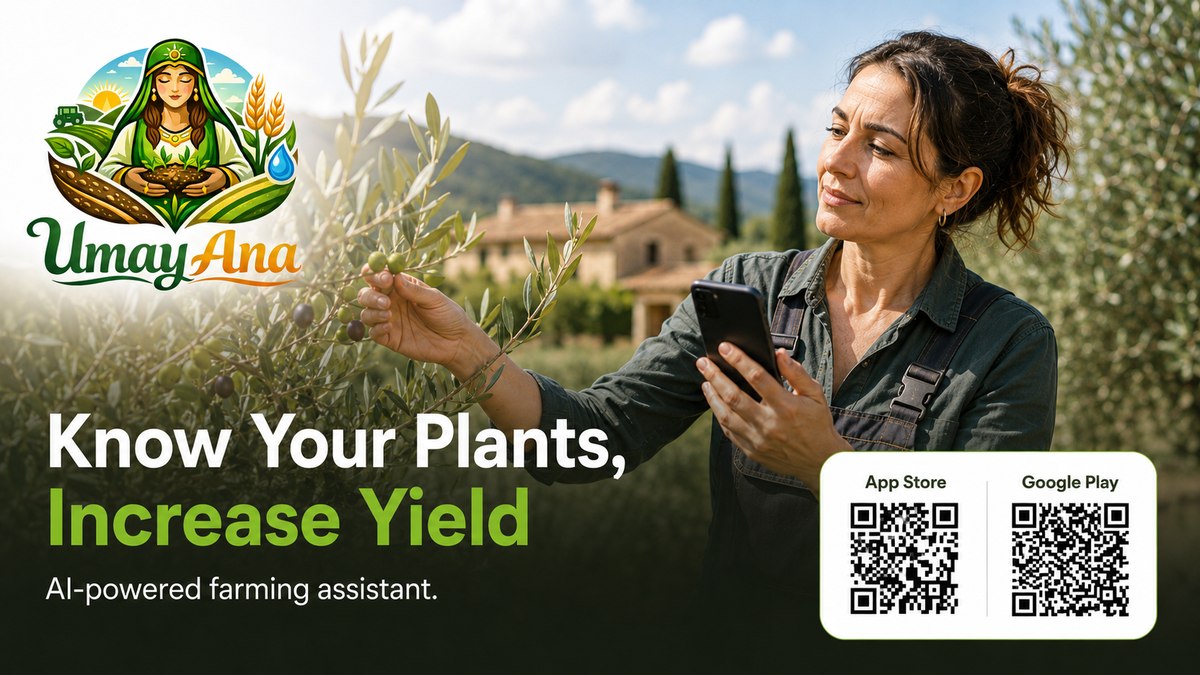
The live app powering the field-data engine
19 languages · Crops + livestock · Structured analysis data · Institutional-scale vision

Umay Ana's long-term value is not limited to subscription revenue. It comes from transforming signals generated by real field usage — processed under appropriate permissions and data policies — into stronger risk models, early warnings and institutional decision tools.
Photo analysis, crop planning, disease and care support, livestock health, ration and production tools create daily user value.
Analysis outputs become meaningful data points through time, crop/livestock type, context, image findings and — where permitted — location information.
The growing data asset can support agriculture-specific models for classification, risk scoring, regional anomaly detection and time-series forecasting.
Portfolio risk indicators, early warning, regional visibility and API-based data products for banking, insurance/reinsurance, public institutions and agribusiness.
The goal is not to accumulate raw data. It is to validate useful signals, aggregate them in privacy-aware ways, and convert them into decision-grade intelligence.
Photos, analysis requests and production inputs.
Health, risk and recommendation outputs.
Enrichment with time, crop, region and confidence.
Regional and temporal patterns from individual analyses.
Credit, underwriting, claims, public and supply decisions.
Better product → more usage → stronger data network.
Core principle: Institutional value is designed to come from aggregated risk intelligence derived from permissioned, safely processed field signals — not from selling personal data.
Climate volatility, agricultural knowledge loss and the insurance protection gap create measurable financial exposure for every institution that lends to, insures, reinsures or supports the food system.
Global agricultural losses from disasters over 33 years (FAO, 1991–2023)
Average annual agricultural loss — roughly 4% of global agricultural GDP (FAO)
Global crop insurance protection gap; ~55% of insurable crop value unprotected (Swiss Re, 2024)
Average US farmer age; producers under 35 make up less than 10% (USDA, 2022)
How much of the world's insurable crop value is protected? (Swiss Re, 2024)
This is where Umay Ana's economic layer emerges: combining field signals by crop, region and time to create new data products for credit risk, underwriting, claims triage, parametric product design, public intervention and supply-chain decisions.
Sources: FAO, The Impact of Disasters on Agriculture and Food Security (2025) · USDA Census of Agriculture (2022) · Swiss Re Institute, Crop Insurance Resilience Index (2024)
The planned token architecture is designed to align high-quality field contribution, expert validation, institutional data demand and AI-service consumption in one economic loop. The design focus is utility and incentives — not speculative appreciation.
High-quality field data, expert validation and targeted data missions can be incentivized through quality scoring and provenance.
Duplicate, low-quality or manipulated data should not earn rewards; confidence scoring, cross-validation and anti-abuse controls are part of the economic design.
The token/credit layer can be designed as a unit of consumption for AI analyses, advanced models, API calls, expert validation or selected data services.
A bank, insurer or ministry could sponsor verified data needs for a crop or region, using economic incentives to direct field participation.
AI compute, data quality, model development and enterprise services create real costs and utility. Token rules should be tied to this measurable activity for sustainable economics.
The token economy should scale only with clear data permissions, privacy controls, enterprise licensing, AML/KYC requirements and jurisdiction-specific regulatory design.
The token layer is a roadmap concept. Final technical, legal and economic design will be developed for applicable jurisdictions before launch. This section does not promise investment returns or token-price appreciation.
Large institutions do not buy raw data; they buy signals that change decisions. Umay Ana's B2B/B2G layer is designed to productize those signals as APIs, dashboards, risk scores and early-warning services.
Decision support combining crop-health, regional stress and harvest-risk signals with agricultural credit portfolio visibility.
Field visibility before underwriting, claims triage, crop-risk trends and supplementary signals for parametric-trigger design.
Country- and region-level agricultural stress clustering, accumulation risk and comparable field indicators across portfolios.
Regional disease/stress signals, intervention priority, subsidy targeting and field-fed early-warning visibility.
Field analytics for crop health, disease spread, production stress and procurement planning across supplier regions.
A low-cost digital observation layer to monitor the field impact of climate-adaptation programs, agricultural lending and regional support.
Umay Ana's scope goes beyond crops — from cattle and small ruminants to poultry, even hobby species like pigeons. Alongside practical tools like feed/ration planning and breeding calendars, it also includes a Carbon Diary where farmers log sustainable practices with photo and location evidence.
Named after Umay Ana, an ancient mother goddess who guards fertility and the earth.
How structured field signals can evolve from farmer utility into agricultural risk and financial decision support.
Enterprise Legal & Trust Center
For banks, insurers, reinsurers, public institutions and agribusiness, we publish a clear framework for contracting, data protection, service levels, security and responsible AI.
Core framework for enterprise licensing, APIs, data, IP, confidentiality, liability and Order Forms.
Open PDF (English)Controller/processor roles, subprocessors, incidents, transfers, deletion and de-identified data.
Open PDF (English)Availability objectives, incident severities, response targets, maintenance and service credits.
Open PDF (English)Access control, data minimization, encryption, monitoring, incident response and shared responsibility.
Open PDF (English)Human oversight, decision boundaries, uncertainty, fairness, traceability and model governance.
Open PDF (English)Documents are provided in English. These documents describe our standard enterprise framework and may be tailored by Order Form / SOW for the customer, jurisdiction, regulatory status and data flow. No ISO/SOC certification is claimed unless a current independent certification or report has actually been obtained.
We are open to working with banks, insurers, reinsurers, ministries, development institutions and agribusinesses on data, risk and AI integration.
Experience the field layer